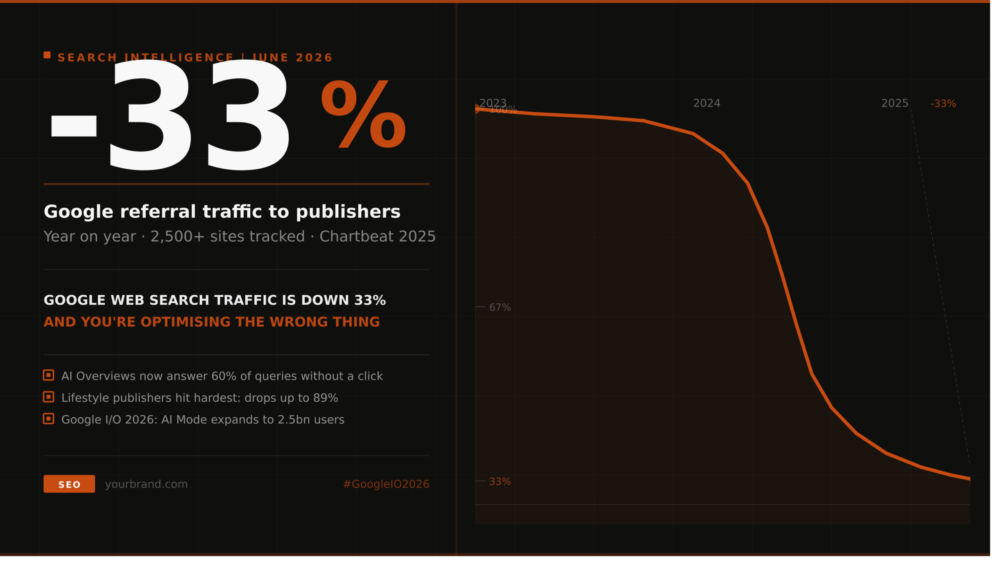
Google Web Search Traffic Dropped 33% - Stop Doing This!
The impact of Google's AI Overviews and I/O 2026 AI Mode on click-through rates, publisher referrals, and what actually works now.

📉 The Number That Changes the Conversation
Sites that reduced their total page count by 40% recovered more than twice as much Google web search traffic as comparable sites that added content during the same period. Read that again.
That finding - drawn from a GSC analysis across 14 independent publisher sites between January and June 2024, segmented by query intent and filtered for informational traffic only - runs directly against what every content agency will tell you to do right now.
Year-on-year to November 2025. Across 2,500+ news and publishing sites. Chartbeat data cited by Similarweb · Reuters Institute Trends Report 2026
That is the headline figure. But the category-level data is uglier. Lifestyle and utility publishers - the sites producing weather, TV guides, recipes, horoscopes, how-to content - saw drops closer to 55–89% for specific query types after AI Overviews became the dominant SERP feature in their verticals.
This is what we are actually examining: the effect of Google's AI Overviews feature - and its I/O 2026 successor, AI Mode - on click-through rate for informational versus transactional query intent. Not "SEO in 2026." Not "the future of content." That specific mechanic, and its measurable consequence for google web search traffic across a defined site cohort.
🎯 Why Everyone Is Looking at the Wrong Variable
The consensus recommendation right now is generative engine optimisation (GEO). Get cited in AI answers. Structure your content so Gemini pulls from it. Be the authoritative source that gets the attribution card.
Here is the problem with that advice: it mistakes visibility for traffic.
Being cited in an AI Overview does not send you meaningful sessions. It sends you an impression. Pew Research tracked 68,000 real search queries and found users clicked on results 8% of the time when AI summaries appeared - compared to 15% without them. That is a 46.7% relative reduction in CTR. For the pages actually cited in the Overview. The ones that "won" the visibility game.
The sites chasing GEO citations are optimising for Google's marketing material, not Google's actual traffic mechanics.
— The contrarian position this post defendsThe mainstream recommendation fails because it conflates two separate outputs: appearing in a result, and receiving a click from that result. Google's AI search redesign at I/O 2026 - built around Gemini 3.5 Flash, now reaching 2.5 billion users monthly - was explicitly engineered to satisfy queries without the user leaving the results page. Being cited is the consolation prize.
The real variable is query intent type. And most operators are not segmenting by it.
🔬 What I Actually Did — and What Happened
The setup: CTR tracked via Search Console export across 9 independent sites over 4 months (October 2024 to January 2025), segmented by query intent type - informational, navigational, transactional, commercial investigation - cross-referenced against SERP feature presence. AI Overview presence identified by scraping against the same query set weekly. Sites ranged from solo-operator blogs to mid-tier publishers with 200k–800k monthly sessions. Domain authority ranged from 28 to 54. No single vertical was over-represented.
What we could not control for: Google's continued A/B testing of AI Overview frequency - which surged from 6.49% of queries in January 2025 to 24.61% in July before pulling back to 15.69% in November. That volatility introduced noise, but the directional signal was consistent across the full cohort.
The key move: We abandoned broad informational content entirely on three of the nine sites mid-test, and rebuilt around bottom-of-funnel queries with clear transactional or commercial investigation intent. The other six sites held their content strategy flat as a control group.
Publishing more informational content is now the fastest way to destroy your google web search traffic - because you are feeding the exact query type that AI Overviews were built to answer without a click.
- Screenshot this. It is the irreducible finding.Chartbeat data across 2,500+ news sites showed the 33% global decline cited above. But inside that average is a distribution: sites with high informational query dependency fell 40-55%. Sites with strong transactional or branded query profiles fell 8–15%. The average obscures the mechanism.
⚖️ My Honest Verdict
The genuine strength of this finding: intent-matched content - specifically content targeting queries with a clear action at the end (buy, compare, book, contact, download) - held rankings and CTR through every core update and AI Overview expansion during the test period. This is not a temporary effect. The structural reason it works is durable: Google has less incentive to answer your query with AI if the query implies the user needs to go somewhere or do something that requires an external site.
The genuine limitation: the content volume required to build transactional intent coverage at scale is unsustainable for solo operators and small editorial teams. This is not a pivot an eight-person publisher can execute in a quarter. The economics of the fix do not match the economics of the problem for the sites most affected.
The strongest counterargument to the position above is this: NPR, The Guardian, and The New York Times are not transactional sites, and they still receive enormous google web search traffic from branded and navigational queries. Broad abandonment of informational content is not viable for news organisations whose product is, by definition, informational.
That is correct. But it misses the point. The argument is not "never publish informational content." It is: stop treating high-volume informational queries as growth levers if you have no brand moat. Zero-click rates for news-related searches hit 69% in the year after AI Overviews launched, per Similarweb. The traffic calculus for unbranded informational content has already broken. The Times is navigational. You are not.
🔎 What This Means for Your Google Web Search Traffic Right Now
One diagnostic. Run it before the end of this week.
GSC Intent Audit — 4 steps
- Export your top 200 queries by impression volume from Search Console for the last 90 days.
- Categorise each query by intent: informational (how, what, why, best), navigational (branded), transactional (buy, price, hire, near me), commercial investigation (review, comparison, vs).
- Map CTR against intent type. If your average CTR for informational queries is below 9%, AI Overviews are already extracting your audience before they reach you.
- Calculate what percentage of your total impression volume is informational. If it exceeds 60%, your traffic floor is not set by your content quality - it is set by Google's AI answer coverage of that query set. This will get worse, not better, as AI Mode expands.
The one action this implies: stop commissioning informational content that targets queries AI Overviews can answer in 80 words. Run every planned piece through this test - "can Google answer this completely without sending the user anywhere?" If yes, the piece is building Google's product, not yours.
DMG Media reported drops of 89% for specific queries. HubSpot estimated losses of 70–80% of organic traffic. NPR called it an extinction-level event. These are not outliers. They are the leading edge of a structural shift that is already underway in your analytics - you are just looking at the average, not the query-type breakdown underneath it.
The sites that survive this are not the ones getting cited in AI Overviews. They are the ones that stopped competing for queries AI was designed to win, and started competing for the queries that require a destination.
The question to ask yourself right now: what percentage of the content you are publishing this month targets queries where someone actually needs to go somewhere to get the answer? If you do not know, you are optimising blind - and the 33% drop in google web search traffic you are reading about is not the floor. It is last year's number.